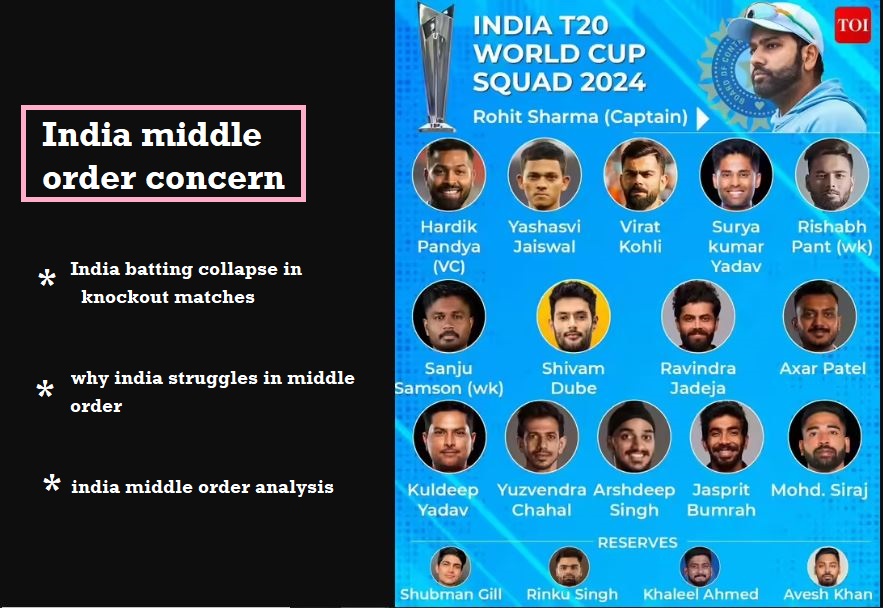
india middle order concern: India has world-class openers, match-winning bowlers, and explosive finishers. Yet, whenever an ICC tournament reaches its pressure moments, one weakness keeps resurfacing — the middle order. Despite years of experimentation and talent depth, India’s middle-order batting remains an unresolved puzzle heading into the next ICC event.
This concern isn’t about lack of skill. It’s about consistency under pressure, role clarity, and adaptability against elite bowling attacks.
Table of Contents
India’s Top Order vs Middle Order: A Clear Contrast
The top order of the India national cricket team has generally delivered strong starts across formats. Powerplay runs are rarely an issue.
The problem usually begins after the fall of the second or third wicket.
Key contrast:
- Top order: Sets platform, scores at healthy strike rate
- Middle order: Struggles to rotate strike, absorbs pressure, loses momentum
In ICC knockouts, this contrast becomes even more visible.
Also read: Ind vs Pak raad: pakistan ne kiya t20 word cup se walkout india ko milega 2 point
Recurring Middle-Order Failures in ICC Knockouts
Over multiple ICC tournaments, a familiar pattern has emerged:
- Early wickets trigger panic
- Partnerships fail to develop
- Boundary droughts increase dot-ball pressure
- Lower order enters too early, increasing collapse risk
Middle-order batters often face peak bowling spells, not tired bowlers — a crucial factor many teams prepare better for than India.
india middle order concern: Lack of Role Clarity at No. 4 and No. 5
One of the biggest issues has been frequent changes in batting roles.
Common problems:
- Players unsure whether to attack or rebuild
- Batters picked for talent, not specific roles
- Inconsistent batting positions across series
Successful teams lock roles months before major tournaments. India, historically, has continued to “experiment” deep into ICC events — a risky strategy.
Pressure Handling: The Mental Gap
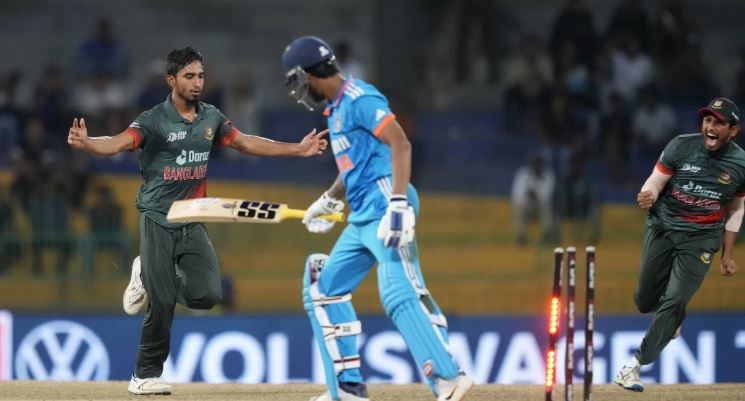
Skill-wise, India’s middle-order batters are among the best in the world. The difference appears when:
- Required run rate climbs
- Fielding sides apply sustained pressure
- Bowlers target defensive weaknesses
In ICC tournaments, pressure is relentless. Teams like Australia and England train specifically for these scenarios. India’s middle order often looks reactive instead of proactive.
Spin and Short-Ball Challenges in Middle Overs
Two tactical challenges stand out:
1️⃣ Quality Spin in Middle Overs
- Difficulty rotating strike against tight spin
- Over-reliance on boundary options
- Rising dot-ball percentage
2️⃣ Well-Planned Short-Ball Attacks
- Lack of counter strategies
- Hesitation between attack and defense
- Increased chances of soft dismissals
Middle overs (15–35 in ODIs) remain India’s weakest phase in pressure games.
Overdependence on Finishers
India has elite finishers, but they are being forced to do too much, too often.
When the middle order fails:
- Finishers arrive too early
- Required rate becomes unrealistic
- Shot selection turns desperate
A stable middle order would allow finishers to play their natural game instead of rescue missions.
What Successful Teams Do Differently
Top ICC-performing teams follow a clear blueprint:
| Factor | Successful Teams | India (Often) |
|---|---|---|
| Role clarity | Fixed | Rotational |
| Middle-order strategy | Situational | Reactive |
| Pressure training | Planned | Limited |
| Batting depth usage | Structured | Emergency-driven |
This difference shows up consistently in knockout matches.
What India Must Fix Before the Next ICC Tournament
To eliminate this recurring weakness, India needs to:
- Finalize middle-order roles early
- Back players through failures
- Simulate high-pressure scenarios in bilaterals
- Improve strike rotation against spin
- Reduce dependency on last-over heroics
Talent is not the issue. Preparation and clarity are.
Final Verdict
India enters every ICC tournament as a favorite — and rightly so. But until the middle order becomes reliable under pressure, that “favorite” tag will continue to feel fragile.
If India solves this puzzle, trophies will follow. If not, history risks repeating itself yet again.
source: espncricinfo, cricbuzz