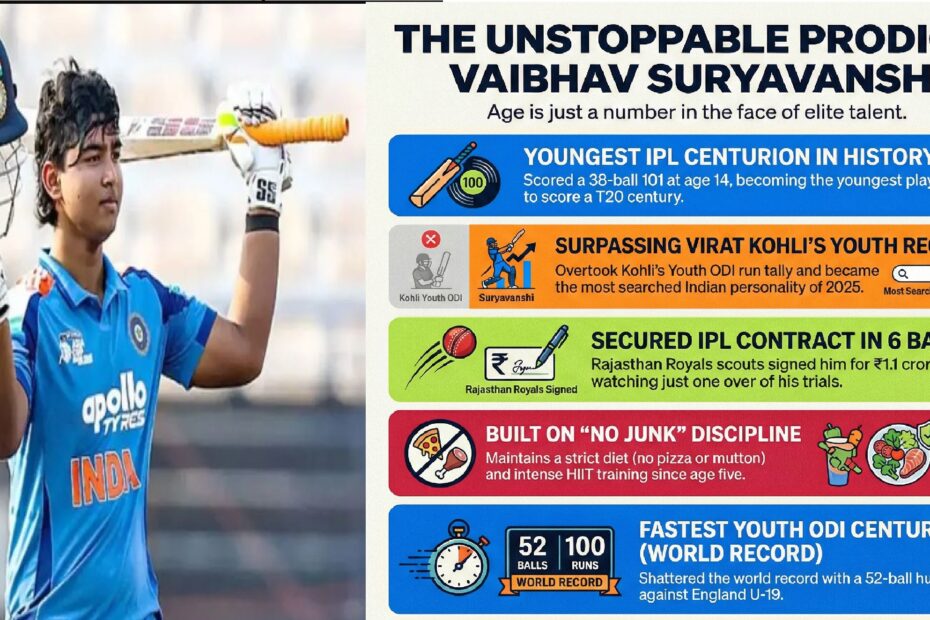
While the world was busy debating the future of Indian cricket, 14-year-old Vaibhav Suryavanshi just provided the definitive answer with a blistering 72-run masterclass.
This wasn’t just another innings; it was a high-stakes statement of intent that rewrote the record books and left veteran bowlers searching for answers.
Most analysts are looking at the scorecard, but what they’re missing is the specific technical shift in Vaibhav’s game that makes this performance a terrifying warning to every international bowling attack.
Table of Contents
1. Introduction: The Kid Who Broke the Internet and the Record Books
In 2025, a 14-year-old from Samastipur, Bihar, achieved the unthinkable. Vaibhav Suryavanshi became the most searched Indian personality of the year.
He even surpassed the search volume of global cricket icon Virat Kohli. This meteoric rise was fueled by an unconventional, grit-heavy journey.
Vaibhav went from backyard drills in Bihar to a 1.1 crore IPL contract. Fans are desperate to understand how a child became a global icon overnight. But how did we get here?
Also read: WPL vs IPL: Key Differences, Revenue, Viewership, and Future of India’s T20 Leagues
2. The Six-Ball Legend: How the “Holy Trinity” Saw the Future
Vaibhav’s entry into the Rajasthan Royals (RR) was not a long scouting saga. It happened during a lightning-fast trial at the High-Performance Center in Nagpur.
Scouts only needed one over—exactly six balls—to see his generational potential. The holy trinity of Indian coaching was present for this revelation.
Rahul Dravid, Zubin Bharucha, and Vikram Rathour were convinced in minutes. RR Manager Romi Bhinder recalls Dravid’s immediate reaction to the boy’s skill.
“Rahul Bhai and Zubin called me and said to keep an eye on him… this boy has some serious talent.” Elite talent is recognizable instantly at the highest levels of the sport.
Franchises now bypass multi-year scouting cycles for such explosive, undeniable prodigies.
3. The “Gill Method”: Cement Pitches and a “Cricket Tragic’s” Sacrifice
Vaibhav’s skills were forged in the sports-starved environment of rural Bihar. His father, Sanjeev, was a “cricket tragic” who failed in Mumbai at age 19.
Sanjeev grinded as a bouncer and toilet cleaner in Mumbai to survive. He eventually moved home, obsessed with the prophetic advice: “Catch them young.”
Sanjeev traveled 100km to Patna three times a week for coaching. Inspired by Shubman Gill, he built a cement pitch at home during lockdown.
This taught Vaibhav to pick up the length early against fast bowling. This methodology proves world-class skills can be forged in isolation.
A cement pitch and a father’s resilience can outweigh any elite academy.
4. “Not Wired to Defend”: The Blueprint of the T20 Native
Technical experts like Abhinav Mukund have dissected Vaibhav’s lethal, unorthodox style. He lacks a traditional “V grip,” relying instead on a predominant bottom hand. This technique prioritizes bat speed and energy transfer over defensive stability.
What is Vaibhav Suryavanshi’s batting style? Vaibhav is a T20 native who uses a “lever-pulley motion” to generate power.
He picks the length instantly and transfers maximum energy behind every ball. His statistics confirm this aggressive, data-driven profile.
He smashed a 35-ball century against the Gujarat Titans in the IPL. This was the second-fastest century in IPL history, trailing only Chris Gayle. Vaibhav is the blueprint for a generation that views “Test” defense as secondary.
5. The Digital Shift: Surpassing “The King” in the Google Era
The 2025 search data highlights a massive cultural shift in Indian fandom. Vaibhav dominated Google searches, moving ahead of “The King,” Virat Kohli. Cricket stars continue to dictate the digital pulse of the entire nation.
Here is the kicker:
A teenager with a handful of matches eclipsed a twenty-year legend. This trend reveals an audience obsessed with finding “the next big thing.”
The IPL possesses the unique power to manufacture global icons in weeks.
6. The Legal Paradox: A Million-Dollar Minor in a “Void” Contract
A complex legal reality shadows Vaibhav’s lucrative 1.1 crore contract. Under the Indian Contract Act of 1872, minor contracts are void ab initio.
This means they are legally void from the very beginning. This stems from the landmark case Mohiri Bibi vs. Dharmadas Ghosh.
The ruling established that minors lack the legal maturity to sign binding deals. In contrast, the UK and Australia use “beneficial contract” models for prodigies.
Researchers at NLU Odisha suggest India needs a “US Coogan Law” equivalent. This would mandate trust accounts to protect a child’s million-dollar earnings.
We must balance child protection with the economic reality of teenage superstars.
7. Conclusion: The Burden of the “14-Year-Old” Label
Vaibhav’s journey from Samastipur to the U-19 World Cup is historic. He has already surpassed records once held by Virat Kohli in Youth ODIs.
Vaibhav scored 1,047 runs in 20 matches; Kohli had 978 in 28. His success is built on a “no junk” fitness code.He has sacrificed pizza, mutton, and even his native litti-chokha. As we chase the “next Kohli,” we must weigh the cultural costs.
Are we ready for a world where children are professional assets before adulthood?
यह भी पढ़ें: IPL vs BBL ( Indian Premier League vs Big Bash League ): A Detailed Comparison with 10 points
यह भी पढ़ें: WPL vs IPL: Key Differences, Revenue, Viewership, and Future of India’s T20 Leagues
Follow us on google news / crictrace hindi and Google news / crictrace English